
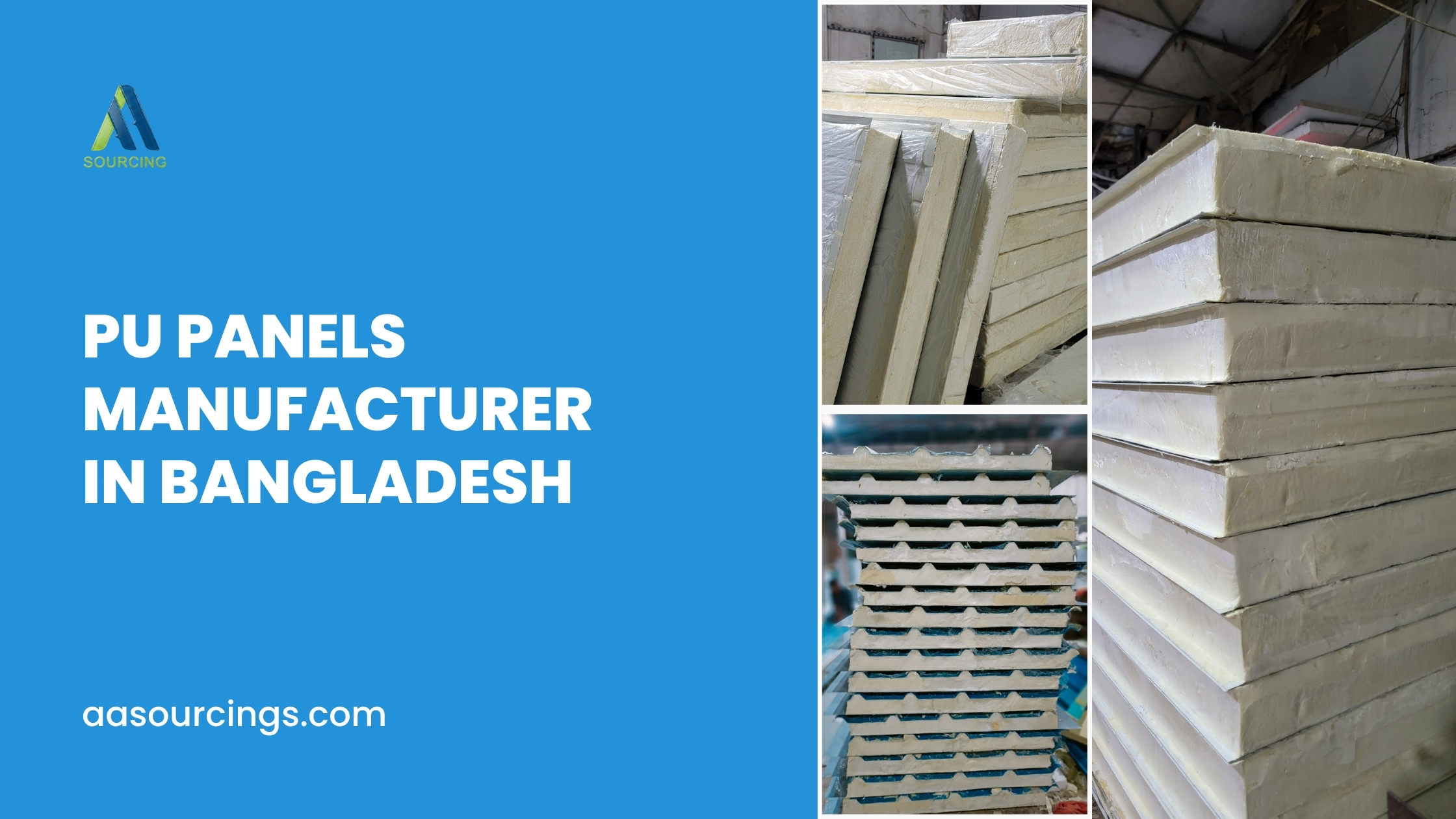
PU Panels: Complete Guide to Polyurethane Sandwich Panels for Modern Buildings
When a building requires effective thermal insulation, fast installation, durability, and controlled indoor temperatures, PU panels are one of the most practical solutions available today. PU panels, also known as Polyurethane Sandwich Panels, combine insulation and building enclosure functions into a single prefabricated panel system.
A PU panel consists of a rigid polyurethane foam core placed between two protective metal sheets. This construction provides excellent thermal insulation while creating a lightweight and durable wall or roofing system. PU panels are widely used in industrial buildings, cold storage facilities, food processing plants, warehouses, factories, cleanrooms, commercial spaces, and other temperature-sensitive environments.
A A Sourcing is a PU panel manufacturer and supplier in Bangladesh, providing PU sandwich panel solutions for different industrial, commercial, agricultural, and infrastructure applications. With suitable thickness, density, dimensions, and surface finishes, PU panels can be manufactured according to project requirements.
What Are PU Panels?
PU panels are insulated sandwich panels manufactured using polyurethane foam as the insulation core. The foam core is bonded between two metal sheets, creating a composite panel with insulation and structural properties.
The three primary components are:
- Outer metal sheet: Provides protection, durability, and surface finish.
- Polyurethane foam core: Provides thermal insulation.
- Inner metal sheet: Creates a finished interior surface and protects the insulation core.
The combination of these layers allows PU panels to perform multiple functions within one building system. Instead of constructing a wall with separate structural, insulation, and finishing layers, PU sandwich panels integrate several requirements into a single prefabricated product.
This makes them particularly useful where construction speed, insulation performance, hygiene, and temperature control are important.
PU Panel Manufacturing in Bangladesh
As a PU panel manufacturer in Bangladesh, A A Sourcing produces polyurethane sandwich panels for projects with different insulation and construction requirements.
The manufacturing process begins with the preparation of the metal facing sheets and polyurethane insulation material. The PU core is positioned between the sheets and bonded under controlled manufacturing conditions. The finished panels are then prepared according to the required thickness, length, profile, and project specifications.
A A Sourcing can manufacture PU sandwich panels with densities around 40–45 kg/m³ and thickness options ranging from approximately 40mm to 150mm, depending on the application and customer requirements.
For projects requiring higher insulation levels, thicker PU panels can provide greater resistance to heat transfer. The appropriate panel thickness should be selected based on the building’s purpose, internal temperature requirements, location, and overall design.
Key Benefits of PU Panels
1. Excellent Thermal Insulation
One of the biggest advantages of PU panels is their thermal insulation capability. Polyurethane foam has low thermal conductivity, helping reduce heat transfer through walls and roofs.
This makes PU panels suitable for buildings where maintaining a more stable internal temperature is important, including:
- Cold storage facilities
- Food processing plants
- Temperature-controlled rooms
- Warehouses
- Industrial facilities
- Pharmaceutical facilities
- Cleanrooms
Effective insulation can also help reduce the load on air-conditioning and refrigeration systems.
2. Faster Installation
PU sandwich panels are manufactured as prefabricated building components. They can be installed considerably faster than conventional brick-and-mortar walls in many applications.
The panels are supplied in predetermined sizes and installed using suitable joining and fixing systems. This can reduce construction time and help projects become operational sooner.
For industrial projects where downtime or construction delays can affect business operations, faster installation can be a major advantage.
3. Lightweight Construction
Despite providing insulation and a finished wall or roof surface, PU panels are relatively lightweight compared with many traditional construction systems.
Their lower weight can make transportation, handling, and installation more convenient. It can also help reduce the overall load imposed on the building structure when properly incorporated into the project design.
4. Suitable for Temperature-Controlled Buildings
Temperature control is essential for many industries in Bangladesh. High outdoor temperatures can create significant heat gain inside buildings, particularly in industrial and commercial facilities.
PU panels provide an insulated enclosure that helps minimize heat transfer. For cold rooms and cold storage applications, they can also help maintain the desired internal temperature by reducing the movement of heat through the walls and roof.
5. Clean and Professional Appearance
PU panels provide a smooth and uniform finished surface, creating a clean appearance for industrial and commercial facilities.
This is particularly useful for facilities where cleanliness and appearance are important, such as:
- Food factories
- Pharmaceutical facilities
- Laboratories
- Cleanrooms
- Commercial facilities
- Modern warehouses
Different sheet finishes and colors can also be selected according to project requirements.
6. Easy Maintenance
PU panel surfaces are relatively straightforward to clean and maintain when appropriate materials and installation methods are used.
The smooth metal surface does not require the same type of routine finishing work associated with traditional plastered walls. Proper installation, sealing, and periodic inspection are important for maintaining long-term performance.
7. Flexible Applications
PU panels can be used for both wall and roofing applications. Their versatility makes them suitable for everything from industrial sheds and warehouses to cold storage rooms and specialized production facilities.
PU Panel Specifications
Choosing the correct specification is essential for achieving the desired insulation and structural performance.
Common factors to consider include:
| Specification | Typical Requirement |
|---|---|
| Core Material | Polyurethane (PU) Foam |
| PU Density | Approximately 40–45 kg/m³ |
| Panel Thickness | Approximately 40mm–150mm |
| Application | Wall, Roof, Partition, Cold Room |
| Facing | Color-coated metal sheets |
| Panel Length | Manufactured according to project requirement |
| Surface Finish | Selected according to application |
| Installation | Suitable jointing and fixing system |
The final specification should be selected according to the project’s design, insulation requirements, environmental conditions, and intended use.
For specialized requirements, A A Sourcing can manufacture PU panels based on customer specifications.
PU Panels for Cold Storage and Cold Rooms
Cold storage is one of the most important applications of PU sandwich panels. Maintaining a controlled temperature requires an insulated enclosure capable of minimizing heat transfer.
PU panels can be used to construct:
- Cold storage rooms
- Chiller rooms
- Freezer rooms
- Food storage facilities
- Dairy storage areas
- Meat and fish storage facilities
- Fruit and vegetable storage facilities
- Pharmaceutical storage rooms
For cold storage applications, panel thickness, joint design, door systems, floor insulation, refrigeration capacity, and installation quality all influence the overall performance of the facility.
Thicker PU panels may be required for applications involving lower temperatures or higher insulation requirements.
PU Panels for Industrial Sheds and Warehouses
Industrial warehouses and production facilities often have large wall and roof areas. Using conventional construction for these structures can involve significant time and material requirements.
PU sandwich panels provide an insulated building envelope that can be used for walls, roofs, partitions, and selected internal areas.
They are suitable for:
- Manufacturing factories
- Distribution warehouses
- Industrial storage facilities
- Garment factories
- Engineering workshops
- Production plants
- Logistics facilities
- Industrial sheds
For facilities where heat reduction and indoor comfort are important, insulated PU panels can provide an advantage over uninsulated building materials.
PU Panels for Food Processing Facilities
Food processing facilities require controlled environments and surfaces that can be maintained hygienically.
PU panels are commonly used for walls, ceilings, partitions, and temperature-controlled rooms in food-related facilities.
Applications may include:
- Food processing rooms
- Bakery production areas
- Meat processing facilities
- Dairy processing plants
- Fish processing facilities
- Packaging rooms
- Chiller rooms
- Food storage areas
The smooth panel surface can support easier cleaning and maintenance when the appropriate panel specification and installation details are used.
PU Panels for Pharmaceutical and Cleanroom Applications
Pharmaceutical manufacturing and other controlled environments require careful consideration of temperature, cleanliness, and internal environmental conditions.
PU panels can be used to create insulated partitions and enclosed spaces in pharmaceutical plants, laboratories, cleanrooms, and controlled production areas.
Proper joint sealing and installation are particularly important in these environments because gaps or poorly finished joints can affect cleanliness and insulation performance.
The panel system should therefore be designed and installed according to the specific requirements of the facility.
PU Panels for Factory Partitions
PU sandwich panels are also useful for dividing large industrial spaces into separate rooms or work areas.
A factory may need separate areas for:
- Production
- Storage
- Quality control
- Packaging
- Office space
- Equipment rooms
- Temperature-controlled areas
Instead of constructing permanent masonry walls, insulated panels can provide a faster method of creating internal partitions.
This can be particularly useful when businesses need to modify or expand their existing facilities.
PU Roof Panels
Heat enters buildings through both walls and roofs. Therefore, insulating only the walls may not provide adequate thermal protection.
PU roof panels are designed to provide an insulated roofing solution that helps reduce heat transfer through the roof.
They can be used for:
- Factory roofs
- Warehouse roofs
- Industrial sheds
- Commercial buildings
- Storage facilities
- Temperature-sensitive facilities
A properly designed PU roof system can contribute to a more comfortable internal environment and help reduce cooling requirements.
PU Panels vs Traditional Brick Walls
Traditional brick construction remains widely used in Bangladesh, but PU sandwich panels offer several advantages for specific industrial and temperature-controlled applications.
| Feature | PU Panels | Traditional Brick Walls |
| Installation Speed | Fast | Generally slower |
| Thermal Insulation | High | Requires additional insulation for higher performance |
| Weight | Relatively lightweight | Heavy |
| Surface Finish | Factory-finished | Requires plastering/finishing |
| Maintenance | Relatively simple | May require periodic surface maintenance |
| Temperature-Controlled Use | Highly suitable | Requires additional insulation |
| Industrial Application | Highly suitable | Suitable but can take longer to construct |
The best choice depends on the building design, budget, insulation requirements, structural system, and intended application.
How to Choose the Right PU Panel
Selecting a PU panel should not be based on thickness alone. Consider the following factors before ordering:
1. Required Panel Thickness
Determine the thickness according to the desired thermal insulation performance and application. Cold storage and freezer rooms may require thicker panels than standard industrial partitions.
2. PU Foam Density
Density is an important factor when evaluating PU panel quality and performance. A A Sourcing manufactures PU panels with densities of approximately 40–45 kg/m³, depending on the product specification.
3. Metal Sheet Specification
The quality and thickness of the outer metal sheets influence durability, appearance, and overall panel performance.
4. Application
A panel designed for a factory partition may have different requirements from one used for a freezer room or industrial roof.
5. Panel Dimensions
Panel length and dimensions should be planned according to the building layout to minimize unnecessary cutting, joints, and material waste.
6. Installation Quality
Even a high-quality PU panel can perform poorly if it is installed incorrectly. Proper alignment, fastening, jointing, and sealing are essential.
Why Choose A A Sourcing for PU Panels?
A A Sourcing provides PU panel manufacturing and supply solutions in Bangladesh for customers looking for insulated building systems.
Our PU panels are suitable for a wide range of applications, from industrial sheds and warehouses to cold storage, food factories, pharmaceutical facilities, cleanrooms, and factory partitions.
We can provide PU panels with different thicknesses and specifications according to project requirements. Our team can also help customers select suitable panel specifications based on the intended application.
Whether you are constructing a new industrial facility or upgrading an existing building, choosing the right insulated panel system can have a significant impact on thermal performance, construction speed, and long-term usability.
Conclusion
PU panels provide a practical combination of thermal insulation, lightweight construction, fast installation, durability, and a clean finished appearance. Their versatility makes them suitable for many applications in Bangladesh, including cold storage, food processing, pharmaceuticals, warehouses, factories, industrial sheds, cleanrooms, factory partitions, and commercial facilities.
The performance of a PU sandwich panel system depends on more than the panel itself. Correct thickness, PU density, metal sheet specification, joint design, installation, and sealing should all be considered during project planning.
As a PU panel manufacturer in Bangladesh, A A Sourcing supplies polyurethane sandwich panel solutions for different industrial, commercial, and temperature-controlled applications. With project-specific manufacturing options, customers can select panel specifications based on their insulation and construction requirements.
If you are planning for insulated building project, A A Sourcing can provide PU panel solutions designed around your project requirements.