
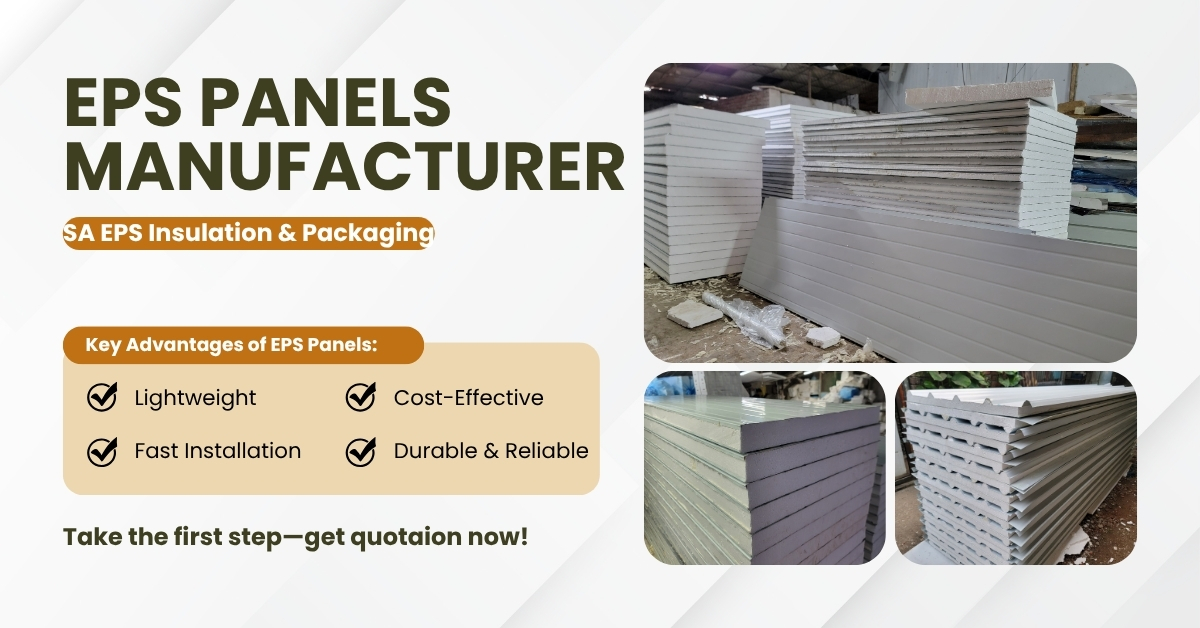
EPS Panels: Complete Guide to Types, Benefits, Applications & Manufacturing
EPS panels are widely used for thermal insulation, partition walls, roofing systems, industrial buildings, warehouses, cold rooms, factories, and prefabricated structures. Their combination of lightweight construction, insulation performance, easy installation, and cost efficiency makes them a practical alternative to conventional brick and concrete construction for many applications.
At A A Sourcing, we manufacture and supply quality EPS panels in Bangladesh for commercial, industrial, agricultural, and construction projects. Our EPS panel solutions can be customized according to project requirements, including panel thickness, dimensions, surface finish, and application.
This guide explains what EPS panels are, how they are manufactured, their key benefits, available types, applications, and the factors you should consider when selecting EPS panels for your project.
What Are EPS Panels?
EPS panels are insulated building panels manufactured using Expanded Polystyrene (EPS) as the insulation core. EPS is a lightweight cellular material consisting primarily of air trapped inside a rigid polystyrene structure. This cellular structure provides effective thermal insulation while keeping the panel lightweight.
An EPS sandwich panel generally consists of three main components:
- Top metal sheet
- EPS insulation core
- Bottom metal sheet
The metal sheets provide structural protection and surface durability, while the EPS core provides thermal insulation and helps reduce heat transfer.
Depending on the project requirements, EPS panels can be manufactured in different thicknesses and dimensions. The appropriate thickness depends on the intended application, required insulation performance, environmental conditions, and construction design.
How Are EPS Panels Manufactured?
The manufacturing process directly affects the quality, consistency, and performance of EPS panels. As an experienced manufacturer, A A Sourcing focuses on maintaining consistency throughout the production process.
1. EPS Raw Material Preparation
The process starts with EPS raw material in bead form. These beads contain a blowing agent that allows them to expand when exposed to steam.
2. EPS Bead Expansion
The EPS beads are expanded using controlled steam. During this process, the beads increase significantly in volume and develop their characteristic lightweight cellular structure.
The expansion process must be properly controlled because the density of the EPS core affects the panel’s insulation properties, weight, strength, and overall performance.
3. EPS Block Formation
After expansion, the beads are stabilized and molded into large EPS blocks. These blocks are then allowed to mature before being processed into insulation boards.
4. Cutting the EPS Core
The EPS blocks are cut into boards according to the required panel thickness. Depending on the application, the insulation core can be prepared in different thicknesses.
5. Panel Assembly
The EPS insulation core is combined with metal sheets to create the sandwich panel structure. Proper bonding between the core and the metal sheets is essential for producing a stable and durable panel.
6. Finishing and Quality Inspection
The finished panels are inspected for dimensions, surface condition, bonding quality, thickness, and overall appearance before being prepared for delivery.
This controlled manufacturing approach helps ensure that EPS panels are suitable for different construction and insulation requirements.
Key Benefits of EPS Panels
EPS panels are popular because they offer several practical advantages compared with many conventional wall and roofing construction methods.
1. Excellent Thermal Insulation
One of the primary reasons for using EPS panels is their thermal insulation capability. The cellular structure of EPS contains a large amount of trapped air, which helps reduce heat transfer through the panel.
This makes EPS panels particularly useful for buildings where maintaining a more stable indoor temperature is important.
2. Lightweight Construction
EPS is significantly lighter than many traditional construction materials. As a result, EPS sandwich panels can reduce the overall weight of wall and roofing systems.
Their lightweight nature also makes handling and transportation easier during construction.
3. Faster Installation
EPS panels are manufactured as ready-to-install building components. Instead of constructing walls layer by layer, contractors can install large panel sections comparatively quickly.
This can help reduce construction time and labor requirements, especially for large industrial and commercial projects.
4. Cost-Effective Solution
EPS panels offer a cost-effective approach to insulated construction. Their lightweight structure, faster installation, reduced labor requirements, and insulation performance can make them an economical option for many projects.
The actual project cost will depend on panel thickness, steel specification, dimensions, quantity, accessories, installation requirements, and other construction factors.
5. Easy Handling
Because EPS panels are lightweight, they can generally be handled more easily than heavy masonry construction components. This is especially useful on projects where materials need to be transported to elevated locations or installed quickly.
6. Suitable for Custom Applications
EPS panels can be manufactured in different thicknesses and dimensions according to project requirements. This makes them suitable for a wide variety of applications, including partitions, walls, roofing systems, industrial structures, and temporary buildings.
7. Clean and Professional Appearance
The metal exterior surfaces of sandwich panels provide a clean and finished appearance. Depending on the selected profile, color, and sheet specification, EPS panels can be used to create neat and professional-looking industrial and commercial spaces.
Types of EPS Panels
EPS panels can be categorized according to their application and construction design.
EPS Sandwich Wall Panels
EPS sandwich wall panels are commonly used for external walls and internal partitions. They combine an EPS insulation core with metal sheets to provide both insulation and a finished wall surface.
They are suitable for:
- Factories
- Warehouses
- Industrial sheds
- Workshops
- Commercial buildings
- Site offices
- Partition walls
- Prefabricated structures
EPS Roof Panels
EPS roof panels are designed specifically for roofing applications. They provide an insulated roof solution while reducing the need for separate insulation layers in certain construction systems.
EPS roof panels can be used for industrial sheds, warehouses, factories, agricultural buildings, workshops, and other structures where thermal insulation is required.
EPS Partition Panels
EPS partition panels can be used to divide large spaces into separate rooms or working areas. They are useful for factory partitions, storage areas, office spaces, production rooms, and other internal spaces.
The installation process is generally faster than building conventional brick partitions.
Applications of EPS Panels
The versatility of EPS panels makes them suitable for numerous industries and building types.
Industrial Factories
Factories often require insulated walls and partitions to create comfortable working environments and separate production areas. EPS panels can be used for factory walls, internal partitions, offices, storage rooms, and utility areas.
Warehouses
EPS panels are frequently used in warehouses where thermal insulation and rapid construction are important. They can be used for both wall and roofing systems depending on the building design.
Industrial Sheds
For industrial sheds and large structures, EPS panels provide a lightweight insulated envelope that can be installed efficiently over a suitable structural framework.
Site Offices
Construction sites frequently require temporary or semi-permanent offices. EPS panels can be used to construct insulated site offices quickly without relying on conventional masonry construction.
Prefabricated Buildings
EPS panels are suitable for prefabricated and modular construction because they are manufactured in controlled dimensions and can be assembled efficiently at the project site.
Poultry and Agricultural Buildings
Agricultural facilities may require improved temperature management and insulated building envelopes. EPS panels can be used in selected poultry farms, agricultural facilities, and related structures depending on the project’s ventilation and environmental requirements.
Cold Storage and Temperature-Controlled Areas
EPS panels can be used in certain temperature-controlled rooms and storage facilities where thermal insulation is required. However, the panel thickness, density, joints, doors, floor insulation, refrigeration system, and other components should be selected according to the required operating temperature and project design.
Commercial and Office Spaces
EPS panels can also be used for internal partitions and selected wall applications in commercial buildings, offices, workshops, and other facilities where rapid installation and insulation are important.
EPS Panels vs Traditional Brick Walls
Traditional brick walls require multiple construction stages, including brickwork, plastering, curing, finishing, and painting. This can increase construction time and labor requirements.
EPS panels are factory-manufactured and supplied as ready-to-install components. Their insulated core and finished metal surfaces can reduce the number of construction stages required for certain building applications.
However, EPS panels and brick walls serve different construction purposes. The appropriate choice depends on structural requirements, insulation needs, fire-safety requirements, budget, building design, and intended use.
For projects where lightweight construction, thermal insulation, and faster installation are priorities, EPS panels can provide an effective alternative to conventional wall construction.
What Thickness of EPS Panel Should You Choose?
The correct EPS panel thickness depends on the project’s insulation and construction requirements. A thicker panel generally provides a greater insulation path, but selecting a panel solely based on thickness is not sufficient.
Important factors include:
- Building location
- Indoor temperature requirements
- Outdoor temperature
- Intended application
- Required thermal performance
- EPS core density
- Metal sheet thickness
- Panel dimensions
- Joint design
- Exposure conditions
- Budget
- Local construction requirements
For example, a panel used for an internal partition may have different requirements from one used for an externally exposed industrial wall or a temperature-controlled facility.
A A Sourcing can help customers select an appropriate EPS panel specification based on their project requirements.
Why Choose A A Sourcing for EPS Panels?
Choosing the right manufacturer is important because panel quality depends on the EPS core, metal sheet specification, manufacturing process, bonding, dimensions, and finishing.
At A A Sourcing, we manufacture and supply EPS panels for different construction and insulation requirements across Bangladesh.
Our focus includes:
- EPS panel manufacturing
- Custom panel dimensions
- Different panel thickness options
- EPS insulation solutions
- Industrial and commercial applications
- Factory and warehouse projects
- Wall and partition solutions
- Roofing applications
- Project-based supply
As a manufacturer, we can discuss project-specific requirements directly with customers rather than simply supplying standard products.
Whether you need EPS panels for a factory, warehouse, industrial shed, site office, partition, agricultural building, or another construction project, we can provide a suitable panel solution based on your requirements.
Factors to Check Before Buying EPS Panels
Before placing an order, buyers should confirm the complete panel specification rather than focusing only on price.
Consider the following:
1. EPS Core Density:
Density affects the physical characteristics and insulation performance of the EPS core.
2. Panel Thickness:
Choose thickness according to the required insulation performance and application.
3. Metal Sheet Thickness:
The thickness and specification of the external metal sheets influence durability and application suitability.
4. Panel Dimensions:
Correct panel dimensions can reduce installation difficulties and material wastage.
5. Surface Finish:
Select a suitable profile, coating, and color based on the building’s design and environmental exposure.
6. Joint System:
Proper panel joints are important for reducing air leakage and improving the overall performance of the installed system.
7. Manufacturer Capability:
A reliable manufacturer should be able to provide consistent dimensions, core quality, metal sheet specifications, and production quality.
Get EPS Panels Directly from the Manufacturer
If you are looking for EPS panels in Bangladesh, working directly with a manufacturer can make it easier to discuss technical specifications, project quantities, dimensions, and customized requirements.
A A Sourcing manufactures and supplies EPS panels for industrial, commercial, agricultural, and construction applications. Our team can help you determine the appropriate panel specification based on your project’s requirements.
From EPS wall panels and partition panels to insulated roofing solutions, we provide practical EPS panel solutions for projects throughout Bangladesh.
Contact A A Sourcing today to discuss your EPS panel requirements and request a quotation for your project.
Frequently Asked Questions About EPS Panels
What are EPS panels used for?
EPS panels are used for insulated walls, roofing systems, factory partitions, warehouses, industrial sheds, site offices, prefabricated buildings, agricultural facilities, and selected temperature-controlled applications.
Are EPS panels suitable for factory construction?
Yes. EPS panels are commonly used for factory walls, partitions, roofing systems, offices, storage areas, and other industrial applications where lightweight construction and thermal insulation are required.
Are EPS panels waterproof?
The EPS core itself has low water absorption, but the overall performance of a panel system depends on the metal sheets, joints, sealants, installation quality, and exposure conditions. Proper installation is therefore important for moisture protection.
Can EPS panels be customized?
Yes. EPS panels can be produced in different thicknesses and dimensions depending on the manufacturer’s production capability and the project’s requirements.
Are EPS panels suitable for roofing?
Yes. EPS roof panels are designed for insulated roofing applications and can be used in industrial sheds, warehouses, factories, workshops, and other suitable buildings.
Where can I buy EPS panels in Bangladesh?
You can purchase EPS panels directly from A A Sourcing, a manufacturer and supplier of EPS insulation and panel solutions in Bangladesh. Contact the company with your required panel thickness, dimensions, quantity, and application to discuss your project requirements.
Conclusion
EPS panels provide a practical combination of thermal insulation, lightweight construction, fast installation, and cost efficiency for a wide range of building applications. From industrial factories and warehouses to partitions, site offices, agricultural buildings, and insulated roofing systems, EPS panels can help simplify construction while improving the thermal performance of a building envelope.
The quality of an EPS panel depends on much more than its appearance. EPS core density, panel thickness, metal sheet specification, bonding, dimensions, joint design, and manufacturing consistency all need to be considered when selecting a product.
As an EPS panel manufacturer in Bangladesh, A A Sourcing provides EPS panel solutions for different project requirements. If you are planning a new construction project, contact A A Sourcing to discuss your requirements and get a suitable EPS panel solution.